The Third Sun Solar 1.76 megawatt installation at the Assurant Specialty Property Service Center in Springfield, Ohio has passed its string tests and is ready to officially go online. We will cut the ribbon on Monday, April 22 at 2pm with officials from Assurant, Springfield Mayor Warren Copeland, State Representative Ross McGregor, and Austin Bingham of U.S. House Speaker John Boehner’s office in attendance. This large solar array, comprising rooftop and parking lot shade canopy components, is now the largest solar installation in the Springfield area. In completing this project with the participation of Tangent Energy and Third Sun Solar, Assurant is making a major statement of corporate responsibility and sustainability. We were proud to team with Assurant, Tangent Energy, and all involved in this large corporate solar project.
Our parking lot solar shade canopies at Assurant Specialty Property in Springfield
As another indication of solar energy’s growth toward mainstream adoption, especially in for-profit business sectors, Wal-Mart has announced that they are shifting from small pilot projects to major deployment of solar energy systems on their stores across the U.S. and around the world. The strategic goal is to produce 100 percent of their stores’ power through renewable energy. This from the dominant discount retailer whose every move is aimed at trimming costs to keep prices as low as possible.
Wal-Mart increases its commitment to clean solar energy
Walmart Ups Ante in Renewable Energy Effort by Christopher Kolomitz
Seeking a path to 100 percent renewable energy at its stores, officials with Walmart said Monday they will increase the number of renewable energy projects the company completes by six times. The announcement comes as company officials look for ways to save on energy costs and meet the goal of 100 percent renewable energy which was previously announced in 2005.
According to Walmart President and CEO Mike Duke the company will drive the production or procurement of 7 billion kilowatt hours (kWh) of renewable energy globally every year, a 600 percent increase over 2010 levels.
Officials said Walmart’s six-fold increase in renewable energy projects is expected to be equal to eliminating the need for roughly two U.S. fossil fuel power plants. Walmart also announced new plans to reduce the kWh/sq. ft. energy intensity required to power buildings globally by 20 percent compared to 2010 levels. The two new commitments are anticipated to generate more than $1 billion annually in energy savings once fully implemented.
“When I look at the future, energy costs may grow as much as twice as fast as our anticipated store and club growth,” Duke said. “Finding cleaner and more affordable energy is important to our every-day low cost business model and that makes it important to our customers’ pocketbooks.”
In 2012 alone, Walmart added nearly 100 renewable energy projects, bringing the total number of projects in operation worldwide to nearly 300 today. The company already is using more onsite renewable power than any other company in the U.S, according to the U.S. Environmental Protection Agency.
In the U.S. alone, Walmart hopes to install solar power on at least 1,000 rooftops and facilities by 2020, a significant increase from just over 200 solar projects in operation or under development currently. The company also plans to invest and develop wind and fuel cell projects and will also procure offsite renewable energy from utility-scale projects, such as large wind projects, micro-hydro projects and geothermal.
From the March/April 2013 edition of Solar Builder Magazine, article by Associate Editor Kelly Pickerel: “Think about this millennial generation… your next generation of employees and your next generation of customers are people who have been taught, since kindergarten, that the Earth must be saved and it’s their job to do it. They have also been taught that the answer to every need is technology. Those ideas are wired into the emerging millennial generation more than any generation that preceded it.”
Just as another semiconductor-based technology–personal computers–shaped the adult lives of the boomer generation, photovoltaic solar and the quest for clean energy may well define the millennials over the next 30-40 years. If it does, the world could be a cleaner, greener, smarter, and more sustainable place.
People often come to us with questions about specific brands of solar panel. We use select panels from a variety of manufacturers, both US-made and imported. If a customer has a preference for a specific brand, we can usually provide them; but part of our mission is to recommend and install the best products, and we sometimes steer customers away from one brand and towards another, based on our research into panel quality and our experience with different brands. Because our top executives are so linked into the best industry sources of information, we can make these recommendations with confidence. We want our customers to have the best system to meet their energy requirements, available space, and budget.
The fact is, most of the solar panels in the market now are quite good. Solar panel technology, and the processes to manufacture, have stabilized and become more standardized over time. Quoting from the SROECO website, “most solar panels on the market are high-quality and will have a guaranteed output of not less than 90% after 10 years and not less than 80% after 25 years. Any brand panel should have this warranty, whether it’s made in China, Germany, or America.” The outstanding exception is Sunpower, widely regarded as the best of all panels, with the highest efficiency rating of any, and also the highest price tag.
For the consumer, a better differentiator than the panel brand or warranty is the experience and reputation of the installer. Third Sun Solar has completed over 350 successful installations; we have been in business for 14 years; and we have a great reputation among our customers. One of our core company values is, “we’re in it for the long haul.” Our 14 years of experience and excellent reputation is what we build and stand upon; we have grown steadily by doing things the right way.
A solar electric system is a 30-year investment that should provide real value over its entire lifespan. In the end, choose an installer who will build your system well and stand by it over time. That is the smartest solar market differentiator.
As we all grow more digital and more electronic (anyone really think that’s going to stop?) we might consider where all that electricity will come from say, 20 years from now. (If it continues to come from burning coal, we’re all in trouble.) By adding productive solar now and migrating more of your energy use to electricity, you can make a significant personal contribution to a cleaner world for ourselves, our kids, and their kids. The power needs of homeowners are projected to increase over time, even with energy efficiency measures; if you think about whether you’re likely to drive an electric vehicle in the next 20 years, likely a plug-in, well, there’s a big bump up in your electricity use right there. And who knows what kinds of electron-juiced gadgets our kids’ kids will have. The point is, our energy needs are likely to increase dramatically over the coming decades. High-performing solar could be the energy bridge that gets us there safely.
If you’re attending this year’s Power Show Ohio at the Ohio Expo Center in Columbus, please stop by and visit us in the Bricker Building, Booth 30. We’ll have information in hand that may be of interest to you.
Kenyon College in Gambier, Ohio (Knox County) has announced that Geoff Greenfield of Third Sun Solar has been selected to deliver this year’s Edgerton Lecture on Tuesday, January 29 at 7pm. The title of Geoff’s talk will be “Solar Power in Ohio: How It Can Grow.”
The Edgerton Lecture Series at Kenyon focuses on energy and the environment. The Series brings visiting scholars to Kenyon College to address energy issues in a public lecture for a general audience, and to provide opportunities for interaction with students, faculty and community members in classes, department seminars and social events. With a theme of sustainable energy and the environment, lectureship topics focus on the challenges of continued dependence on fossil fuels, the impact of their combustion on the environment, and alternative sustainable energy systems.
In addition to the 7pm lecture, Geoff Greenfield will conduct an open Q&A session during Kenyon’s Common Hour at 11am, at Peirce Lounge. The evening lecture will be held in the Community Foundation Theater in Gund Gallery, followed by a reception at The Village Inn.
Green America Voters Select Solar Firm From Among 100+ Nominees
ATHENS, OHIO—Green America, a national advocacy group for sustainable practices that is based in Washington DC, today announced the three winners of their Summer 2012 People and Planet Award. Among the winners is Third Sun Solar, a solar electric design/install firm based in southeast Ohio. The other two winning firms are located in Maryland and South Carolina.
Michelle Greenfield, CEO of Third Sun Solar, stated that the award will help her business take new green steps in their offices and community. “With our award money, we will soon be establishing our new office composting system and teaching the other businesses in our building how to compost with us,” said Michelle. “We will be reducing our company’s carbon footprint by doing an energy-efficiency lighting retrofit, and we will be installing some solar power with our local Habitat for Humanity chapter. Thank you to all those who voted for us, for making these opportunities possible!”
Green America is a not-for-profit membership organization founded in 1982. Its mission is to harness economic power—the strength of consumers, investors, businesses, and the marketplace—to create a socially just and environmentally sustainable society. The organization publishes a magazine, Green American, as well as The National Green Pages. They also coordinate the Green Business Network, in which Third Sun Solar is a member.
Green America’s People & Planet Awards are awarded quarterly; nominated organizations are first narrowed down to a top-ten list, then put to a popular vote, with the top three vote getters winning the award. Past winners have included Aveda, the Calvert Foundation, Clif Bar, Green Kid Crafts, Honest Tea, Organic Valley, and Seventh Generation. See www.greenamerica.org for more about this organization.
[av_one_half min_height=” vertical_alignment=” space=” custom_margin=” margin=’0px’ padding=’0px’ border=” border_color=” radius=’0px’ background_color=” src=” background_position=’top left’ background_repeat=’no-repeat’ animation=”]
[av_textblock size=” font_color=” color=”]
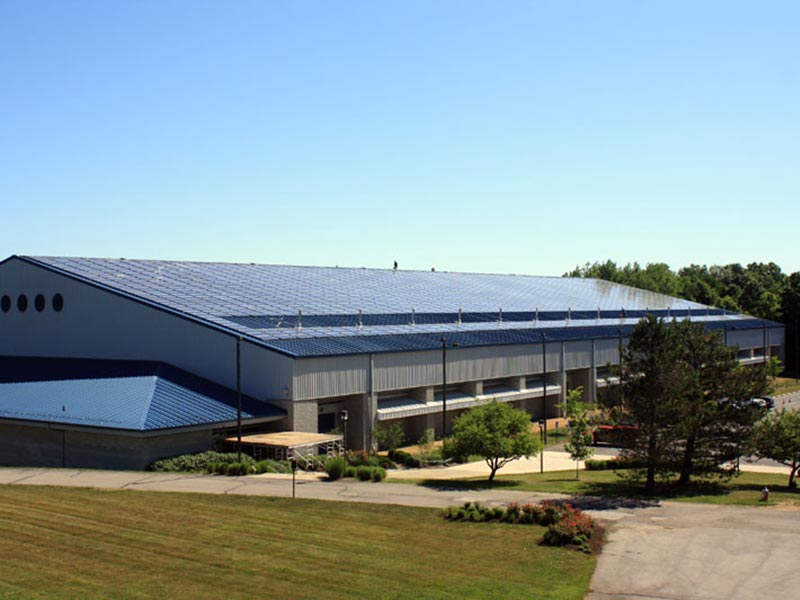
Nearing completion when this photo was made, the Kent State University Field House solar array comprises 1,716 solar panels. It is a strong visual reminder of Kent State’s commitment to sustainability and the environment. Upon commissioning, this array will provide about a third of the total power required by the Field House and the adjacent Dix Stadium, and will eliminate roughly 779,000 pounds of CO2 emissions each year.
[/av_textblock]
[/av_one_half]
[av_one_half min_height=” vertical_alignment=” space=” custom_margin=” margin=’0px’ padding=’0px’ border=” border_color=” radius=’0px’ background_color=” src=” background_position=’top left’ background_repeat=’no-repeat’ animation=”]
[av_textblock size=” font_color=” color=”]
Nearing completion when this photo was made, the Kent State University Field House solar array comprises 1,716 solar panels. It is a strong visual reminder of Kent State’s commitment to sustainability and the environment. Upon commissioning, this array will provide about a third of the total power required by the Field House and the adjacent Dix Stadium, and will eliminate roughly 779,000 pounds of CO2 emissions each year.
[/av_textblock]
[/av_one_half]
Athens, Ohio (May 31, 2012)—In a time of speculation and worry over rising gas prices, utility rate hikes, and global climate change, many still consider renewable energy too costly.
Despite the continuing decline in the cost of solar power components, some policymakers and media voices (and some of the general public) continue to regard solar as “too expensive.” It comes up time and again on surveys. The fact is, the financial costs of solar are front-loaded—once the system is working, the fuel is forever free, and solar creates no emission or pollution. It’s a different cost equation than we see with fossil fuels, where unpredictable fuel costs go on forever, and the environmental costs are kicked down the road for future generations to bear.
A recent study* challenges the “solar is too expensive” slant by unraveling the actual costs and actual benefits that clean solar power generation provides to electric utilities, ratepayers, and taxpayers. After analyzing all the data, the study authors concluded that solar PV installations can deliver real value of $0.15/kWh to $0.40/kWh to ALL ratepayers and taxpayers, not just those installing solar systems.
Authored by Richard Perez at the University of Albany, Ken Zweibel at the GW Solar Institute, and Thomas E. Hoff of Clean Power Research, the study’s report declares, “It is clear that some possibly large value of solar energy is missed by traditional analysis.”
Although government- and utility-based incentives have proven to be a vital driver of solar power growth, the authors argue that the gulf between “inexpensive” conventional energy and “expensive” solar is far smaller than often portrayed, especially when larger public benefits are considered.
“This large apparent ‘grid-parity gap’ [between renewable energy costs and traditional grid-power costs] can hinder constructive dialogue and … weaken political support for solar incentives, especially during tight budgetary times,” the authors wrote.
According to the report, there is another way to look at incentives: as a logical means of transferring value from the public (ratepayers/taxpayers) to those who invested in the solar plants creating the $0.15/kWh to $0.40/kWh in direct solar benefits we all share.
How can this be? Where do these supposed public benefits come from, and what are they, exactly?
The Perez/Zweibel/Hoff report breaks down the shared-by-all public value of solar into nine specific accrued benefits. (The data used to derive the dollar values of these benefits was gathered and analyzed not in sunny Southern California or the Arizona desert, but in relatively non-sunny New York City.)
1. Savings on wholesale energy (comprise $0.06-$0.11/kWh of the total $0.15/kWh-$0.40/kWh). Locally generated clean electricity from residential and commercial solar installations reduces the amount of power that the public utilities must purchase at higher prices on the wholesale market.
2. Reducing demand-response expenses ($0.00-$0.05/kWh). “PV solar installations can deliver the equivalent of capacity, displacing the need to purchase this capacity elsewhere, e.g., via demand response,” the report explains.
3. Savings on energy losses within the distribution system ($0.00-$0.01/kWh). Distributing grid power is expensive and inefficient. When energy is moved from large power plants to local loads, electrical losses typically occur. These losses are much lower with distributed solar generation, where solar is built close to the load.
4. Reduced need for feeder equipment upgrades ($0.00-$0.03/kWh). Because distributed PV can deliver capacity at the feeder level, it can reduce the wear and tear on transformers and other feeder equipment.
5. Hedge against fuel-price spikes ($0.02-$0.03/kWh). “Solar energy is unaffected by fuel commodity price spikes—the fuel is free sunlight. traditional fuel commodity prices fluctuate on short-term scales and will likely escalate substantially over the long term,” the report says.
6. Grid stability ($0.03-$0.06/kWh). Solar power’s ability to closely mirror peak power demand can help reduce the chances of blackouts that can occur when the existing power system is overly stressed. [Peak grid demand normally occurs on hot summer afternoons, when solar is most productive and can add power to the grid when it needs it most.] Power outages currently cost the U.S. economy approximately $100 billion annually, according to the report.
7. Health-related and environmental gains ($0.03-$0.06/kWh). The deployment of solar power displaces the greenhouse gas emissions, mining-related consequences, water contamination, and other environmental- and health-related damages associated with fossil fuels. The $0.03-$0.06/kWh figure cited is “certainly a conservative range,” the report adds.
8. Long-term taxpayer benefits from reduced fuel-price volatility ($0.03-$0.04/kWh). Using an estimate of a 150% rise in fuel-based generation costs by 2036 (widely considered a conservative estimate), the report found that the “insurance hedge” of solar generation contributes a significant long-term value—less government spending on fuel reserves—in addition to the short-term fuel-price hedge value mentioned earlier.
9. Economic boost. The job-creation benefits of solar power have been demonstrated in numerous studies. Moreover, “Job creation implies value to society in many ways, including increased tax revenues, reduced unemployment, and an increase in general confidence conducive to business development,” the report explains.
*“Solar Power Generation in the U.S.: Too Expensive or a Bargain?” by Perez, Zweibel, Hoff.
Adapted from SOLAR INDUSTRY MAGAZINE, August 2011—Hidden Cost Savings: The Top 9 Public Benefits Of Installing Solar Power by Jessica Lillian
UPCOMING EVENT Upcoming Saturday June 23, the annual SpiceBush Festival in Athens, Ohio—Third Sun Solar will deploy our solar trailer as a FREE CELLPHONE-RECHARGING STATION during the festival, which features live bands, craft brews, arts and crafts, food samples, and three types of brews made with Spicebush berries. There will be interactive children activities and educational talks about ways to use spicebush, as well as a spicebush cook-off at 4 p.m. Stop by our solar trailer and let us recharge your cell phone or camera.
ABOUT THIRD SUN SOLAR
Founded in 2000, Third Sun Solar is at the forefront of the emerging Ohio clean energy industry—a growing resource for 21st-century jobs. For more than a decade, the company has custom designed and installed over 300 renewable energy systems for its commercial, institutional, government, and residential customers across the Midwest. Third Sun Solar employs a team of NABCEP-certified solar energy system installers along with system designers, financial analysts, grant specialists, and support staff, all focused on making it easy for customers to go solar. The company combines financial and management experience, highly trained installation crews, privileged supply agreements with leading equipment manufacturers, a network of professional services partners, and advanced internal systems to deliver a smooth transition to solar energy at any scale. An Inc. 5000 company in 2009, 2010, and 2011, Third Sun Solar is a great choice for making your move to clean solar energy.
Pew Roundtable Explores Ideas for Accelerating U.S. Clean Energy Industry
Athens, Ohio—The Pew Charitable Trusts Clean Energy Program recently convened a roundtable discussion to explore ideas for accelerating growth and competitiveness in the U.S. clean energy industry. This was the second of a half-dozen nationwide roundtables that Pew is hosting to gather expert input on the state of the U.S. clean energy economy and strategies for enhancing America’s competitive position. The ideas from these roundtables will be compiled by Pew into a “Blueprint for American Clean Energy Competitiveness.”
The roundtable was convened in collaboration with The Central Ohio Clean Energy Manufacturing Solutions Hub, Advanced Energy Economy of Ohio, Edison Welding Institute, and The Ohio Manufacturers Association. Approximately 30 industry leaders participated, including executives from GE Energy, AEP Ohio, Babcock & Wilcox, Rolls-Royce Fuel Systems, and Third Sun Solar.
The Pew roundtable focused on the issue of clean energy manufacturing in Ohio and, by extension, the U.S. The information gathered during the event will help inform Pew’s year-long effort to develop a comprehensive U.S. clean energy competitiveness strategy. The roundtable gathered a diverse group of business executives that crossed technology interests and areas of expertise. The group featured executives who know their industries well, are comfortable speaking candidly, and most importantly, can offer expert advice for steering policymakers to key issues in stimulating investment, business development, job creation, and progress across the U.S. clean energy supply chain.
During the roundtable, significant time was spent on issues currently impacting clean energy manufacturing in Ohio and across the nation, including:
Government policies regarding renewable energy
Financing and investment
Grid parity
“Bankability”
Tax laws
Regulatory changes and inconsistent policies
Free market policy directions
It is hoped that outputs from the Pew roundtables will encourage policymakers to renew the production tax credit, pass a clean energy standard, and support innovators, entrepreneurs, and industry in developing the world’s most advanced, cost-competitive clean energy technologies for Americans to use and export around the world.
Statement from the Pew Charitable Trusts Clean Energy Program
Energy is a key pillar of our lives—it runs our cars, charges our computers, and powers our factories. Globally, energy use is expected to increase 35 percent over the next 25 years, driven almost entirely by demand due to increases in electricity use and vehicle fleets. The growing need for energy around the world is likely to make it an ever more precious commodity—forcing up prices and increasing global instability. Additionally, the world’s energy sector is responsible for approximately 70 percent of global carbon emissions, the direct cause of climate change. A business-as-usual approach to energy policy threatens global economic competitiveness, national security, and the environment. We must fundamentally transform the manner in which we produce, distribute, and consume energy if we are to reduce dependence on oil, create jobs, enhance global competitiveness, and decrease carbon emissions.
First renewable energy project will reduce carbon emissions on Kent State campus
Athens, Ohio— Kent State University in Kent, Ohio, is installing 1,716 solar panels on the Kent State Field House. Covering almost one acre of roof area, this installation is believed to be the largest roof-mounted system among Ohio’s public universities. Scheduled to be completed in July, it is the first renewable energy project for Kent State, and is being completed by Third Sun Solar of Athens, Ohio.
The solar array will generate about 500,000 kilowatt hours of clean electricity per year – about one-third of the annual consumption of both the Field House and Dix Stadium, or enough to power about 50 average homes. The project will eliminate an average of 779,000 pounds of carbon dioxide (CO2) emissions per year, which is roughly equivalent to removing 70 cars from the road per year.
“We have been searching for funding opportunities to install solar panels on this roof for many years, and it is great to see the installation underway,” said Tom Euclide, Kent State’s associate vice president for Facilities Planning and Operations. “The benefits of adding this renewable energy source to our campus energy portfolio will not only help keep our costs lower for decades to come, but will also provide a visual reminder of Kent State’s leadership in sustainability, energy conservation, and the use of renewable energy.”
“Facilitating the installation of energy-saving technologies—and now, renewable solar energy systems—is extremely satisfying,” said Robert Misbrener, project manager, sustainability, energy conservation, commissioning in the Office of the University Architect at Kent State. “The true goal is to demonstrate our stewardship of the environment and empower generations of students to carry that mission to the world.”
Kent State does not initially own the solar panel system, but will purchase all of the electricity produced by the system, while retaining the option to purchase the system after seven years. Some larger system components are being included to allow for the potential expansion of the Kent State Field House facility.
“Potentially, the sun’s energy can fulfill all of the world’s power needs many times over,” Misbrener said. “Sunlight contains energy that can be turned into electrical current, which can be harnessed for power. There are no harmful emissions from the sun as an energy source; it won’t run out, and best of all, it’s free.”
Kent State already produces most of its own energy in its combined heat and power plant that uses natural gas to power electric turbines. The heat typically released into the atmosphere by a power plant is, instead, saved and used to heat and cool the campus, making the university’s power production substantially more energy efficient than utility power systems. The university will reduce its fossil fuel consumption as it continues to develop renewable energy as one of its sustainability initiatives.
In an article examining small businesses wanting government to invest in clean energy, Michelle Greenfield and Third Sun Solar shine as successful examples of the growing green economy.
Across the United States, Main Street small businesses are working to rebuild our economy. These entrepreneurs are doing all they can to hire, grow and move their businesses forward. And they’re doing it largely through innovation — particularly in the clean energy arena.
Across all industries and at both ends of the political spectrum, entrepreneurs overwhelmingly support government investing in renewable energy and creating clean energy policies that will help guide them into a new economic sector….
A new AEP program pays you for 15 years of renewable energy credits (RECs) in one lump sum, up front—as soon as your solar energy system is installed & certified.
A powerful incentive to go solar
Up to 50% of your system cost can be paid to you by AEP in exchange for 15 years of your SRECs (Solar Renewable Energy Certificates). That guarantees a good return for 15 years worth of your energy credits—paid up front—and brings the total cost of your system into affordable range.
SRECs are generated when you generate clean solar power. AEP is buying up solar customers’ SRECs, in part, to meet their own clean-energy mandates. But this is a limited time opportunity; once AEP’s SREC budget is spent, the program will end.
Use the energy of tomorrow, today
Clean solar power offers a wealth of advantages, not the least of which is—a cleaner planet for your kids’ kids and their kids. Leave them a profoundly positive legacy—a cleaner, smarter way to power their planet. Every step in the solar direction brings us closer to a cleaner world for everyone.
We’ll help make it happen
Third Sun Solar will design and install your solar energy system, help you register it, and guide you through the AEP paperwork to secure your RETP payment. We’ll make it easy for you. Give us a call today to get started!
Invest now in clean energy
No one knows for sure where fossil fuel prices are going… but the smart money says they’re going up. A clean solar energy system will provide power for 30+ years, and the fuel is free—it rises every morning.
Add clean solar now through Third Sun Solar and get this direct payment from AEP. We’ll help with all the details.
In any young, developing industry, turmoil is inevitable — in fact, turmoil is an indicator of growth. Those of us who work in the industry — and those of us considering solar for our home or business — sometimes get caught up in the details of our specific projects, and lose sight of the bigger solar picture. The Solar Energy Industries Association (SEIA)® has just released these statistics for 2011, which show that, for all the growing pains, solar is indeed growing! Take a look at these impressive stats — here are some highlights:
Eight U.S. states installed over 50 megawatts of solar in 2011
In 2009, only two PV projects over 10 megawatts were completed in the U.S. In 2010, the number rose to eight. In 2011, 28 such projects were connected to the grid.
The U.S. installed 776 megawatts of solar in Q4 2011, up 64 percent over Q3 2011 and up 115 percent over Q4 2010. Every market segment had a record quarter, as did ten individual states.
The U.S. installed 1,855 megawatts of PV in 2011, up 109 percent from the 887 megawatts installed in 2010. Growth occurred in every market segment and in 18 of the 23 states we track closely. The value of all PV installations rose to $8.4 billion, up from $5.0 billion in 2010.
We are a woman-owned business, recognized as a Disadvantaged Business Enterprise (DBE) through the state of Ohio’s Unified Certification Program. We are EDGE-certified and federal HUBzone-certified.
Doctor Sudhir Sehgal, DDS Expands Use of Solar Panels to Three Central Ohio Locations
Athens, Ohio—A top-rated dentist in the Columbus area has taken a leadership position in clean energy by installing Solar PV Systems on all three of his dental practices. In the face of Ohio Utilities increasing energy prices on January 1st of this year, Dr. Sehgal says, “Why not? Continue reading “AREA DENTIST GOES GREEN IN A BIG WAY”
[box]We do not inherit the earth from our ancestors; we borrow it from our children. —Native American Proverb[/box]
Third Sun Solar Offers Residential Referral Program
At Third Sun Solar, we have been building our business one system and one customer at a time, and seeing a surprising amount of growth from word of mouth—customers telling a friend, or a friend of a friend. So we have decided to begin rewarding our customers for those referrals.
If a friend or neighbor of yours has shown interest in your solar energy system, and might be a good candidate for their own solar energy, at home or at their business, please provide us with their contact information and help introduce us.
If you do this, we can offer each of your referrals a special premium—a $250 Visa Gift Card, courtesy of Third Sun Solar and courtesy of you—for installing a 5kW or larger solar system. And if they install a system, we can also reward you with a $250 Visa Gift Card. This offer is good until February 15, 2012.
There is no limit to the number of referrals you can give us—and we will reward you for each one. But referrals must sign a contract by this February 15 for the rewards to be paid. The $250 reward applies to systems 5kW and larger, with rewards being pro-rated for smaller systems.
For more information, please give us a call at 740-249-4533. Thanks!
Third Sun Solar Short-Listed for Major Innovation Award
ATHENS, OHIO—Third Sun Solar has been listed as a semi-finalist for the 2011 TechColumbus Innovation Awards, recognizing outstanding achievements in technology and innovation in Central Ohio.
Presented by TechColumbus, the annual Innovation Awards recognize outstanding achievements in technology leadership and innovation. From hundreds of entries, 13 outstanding leaders and teams who exemplify the best in technology leadership and innovation in 2011 will be honored during the Innovation Awards Ceremony on February 2, 2012 at the Greater Columbus Convention Center.
Of the 13 award categories in this year’s event, Third Sun Solar is listed for its contributions in the Green Innovation segment. It shares this recognition with other firms that have developed a Green product or service that is commercially available and in production, and is in use with at least one customer/client; or that have applied or implemented a technology or process change that has a net positive impact on the environment.
About TechColumbus
TechColumbus is the catalyst for technology-driven economic growth in Central Ohio. Its goal is to accelerate innovation, business growth, job creation, and prosperity in the 15-county region of Central Ohio. TechColumbus works to create new companies, strengthen existing businesses, open doors to technology resources, and support the attraction and retention of technology-based businesses and talented people.
Linking the efforts of top technology enterprises, TechColumbus reaches out to the foremost research and development firms in the area—including The Ohio State University, Battelle, Columbus Children’s Research Institute, OhioHealth, 15 Fortune 1,000 companies, and thousands of tech-based and tech-enabled companies. TechColumbus facilitates collaboration among these tech assets and provides resources and assistance to accelerate business and overall economic progress.
THIRD SUN SOLAR PEOPLE: MEET JAMEY JONES
If you have ever sought a residential remote estimate from Third Sun Solar, or needed help getting your solar array certified and registered to sell your SRECs, chances are you’ve spoken—or at least emailed—with Jamey Jones. She is one of our mainstays—another Third Sun employee who does multiple things well, and without whom we wouldn’t be able to function as we do.
Jamey came to Third Sun Solar in 2008 as a receptionist—a position known within the company as a launch pad, as we keep finding great people to answer the phones and promoting them into other jobs here. Jamie was soon doing economic and solar performance modeling for residential systems, and became part of our sales team, handling inside work for all residential sales—completing remote estimates, interfacing with the Public Utilities Commission and GATS, and serving as liaison to all residential customers and projects.
What led Jamey to Third Sun Solar? Mainly, it was her abiding interest in wellness and being green. She had previously worked at the Farmacy Natural Foods Store in Athens; developed health food recipes for a local clientele; provided organic landscaping services for area clients; and worked with Passion Works Studio in Athens as a lead production artist, making collaborative art with adults with and without developmental disabilities.
Having come to the Athens community over twenty years ago as an Ohio University student, Jamey has put down roots here. She is the proud parent of two amazing kids—daughter Lilah (again on course for straight A’s at Athens city schools) and younger son River, aptly named for being a source of boundless energy.
What matters most to Jamey is that her work has environmental and/or social value—that it makes the world a better place for her children.
IN THE NEWS—STATE GRANT PROGRAM, OHIO UPDATE
Energy Loan Fund Replaces State Grants for Renewable Energy Systems
This past year, the State of Ohio Department of Development, Office of Energy announced that it was suspending the grant program for solar installations. The ODOD Office of Energy administers incentive programs through the Advanced Energy Fund to support investments in renewable energy and energy efficiency projects in the industrial, commercial, and residential sectors. To that end, on December 15, 2011, the Office of Energy launched the Energy Loan Fund that applies funds through the Advanced Energy Fund along with federal funds from the State Energy Program to offer low-interest loans to those seeking to add renewable energy systems to their homes.
The new program is not a grant. It is a loan program that requires credit approval and carries up-front and annual fees, and for that reason, is not nearly as attractive as the former grant program. However, solar panel prices have been falling, and we are willing to review and re-do the performance and economic modeling we may have previously performed for you. We may be able to offer better pricing than we could before.
Our take on this is that some customers may benefit, but not nearly as much as during the previous grant period. With solar panel prices falling, the Federal Tax Credit and depreciation rules still in place, and the Energy Loan Fund, there may be enough incentive in place to persuade more people to go solar. 2012 should show us whether the move to clean energy is ready to climb the adoption curve and see more of a mainstream embrace.
IN THE NEWS—EXCERPTED FROM RENEWABLE ENERGY WORLD, JANUARY 2012
Gainesville, Florida Becomes a World Leader in Solar
By John Farrell
You don’t have to be big to go big on solar power. That’s the lesson from the Gainesville Regional Utilities, the electric utility whose feed-in tariff solar policy has brought over 7 megawatts (MW) of solar to the city’s 125,000 residents. The raw number isn’t much, but it puts Gainesville among the world leaders in solar installed per capita, beating out Japan, France, and China (and besting California, with 32 kilowatts -kW- per 1,000 residents).
[box]If we were to advocate for, and gain, such policies here in the Midwest, we could put Ohio and the surrounding states on the solar map—and make a dramatic step toward moving away from electricity generated by burning coal. Want to take action on that? You can begin by sending this article to your local municipal electric utility. [/box]
The basic premise behind the feed-in tariff program is that anyone who wants to be a solar power generator can connect to the grid and get a 20-year contract for their power from the municipal utility.
The long-term contract makes getting financing for solar projects easier and the prices are attractive. The utility pays 24 cents per kilowatt-hour generated for large-scale ground-mounted systems and up to 32 cents for small, rooftop systems.
The price differentiation helps accommodate solar arrays of various sizes, from residential to larger commercial installations, spreading the economic opportunity. The differentiation may also help small-scale residential projects that can’t use federal tax incentives for businesses (depreciation).
Thus far, approximately one-third of the city’s 7.3 MW of solar power is in relatively small systems 100 kW and smaller. About half the installed capacity is in projects 500 kW and larger.
The solar feed-in tariff program also brings value to the local community and electricity system. A report released earlier this year found that the grid benefits and social benefits of solar power far outweigh the typical valuation of solar power by utilities. These benefits include reduced stress on the utility distribution system and reduced transmission losses.
The feed-in tariff program also means local economic development. With a rule of thumb of eight jobs per MW, according to a University of California, Berkeley, study of the jobs created from renewable energy development, Gainesville has already generated 56 jobs. The National Renewable Energy Laboratory has estimated that each megawatt of solar adds $240,000 to the local economy, and if Gainesville’s solar projects are locally owned, the value could be much higher.
More than anything, Gainesville provides an important lesson in local energy self-reliance. While many communities must await action by a state legislature or investor-owned utility, the municipal utility has the authority to act quickly in support of the community. And when the utility is locally controlled, it can mean big things for local solar power.
ABOUT THIRD SUN SOLAR
Founded in 2000, Third Sun Solar is at the forefront of the emerging Ohio clean energy industry—a growing resource for 21st-century jobs. For more than a decade, the company has custom designed and installed over 300 renewable energy systems for its commercial, institutional, government, and residential customers across the Midwest. Third Sun Solar employs a team of NABCEP-certified solar energy system installers along with system designers, financial analysts, grant specialists, and support staff, all focused on making it easy for customers to go solar. The company combines financial and management experience, highly trained installation crews, privileged supply agreements with leading equipment suppliers, a network of professional services partners, and advanced internal systems to deliver a smooth transition to solar energy at any scale. An Inc. 5000 company in 2009, 2010 and 2011, To learn more, please visit our website at kokosingsolar.com.
TESTIMONIAL
ON THE JOB
Third Sun Solar installers completing a 5.4kW SunPower panel systemon a standing seam metal roof in Coshocton, Ohio